

About Us
“Power Solution Services” founded by Mr. Sanjeev Kumar Garg in 2001 at Vadodra (Gujarat), then did set up in Noida in 2004, is one of the Top AMC service provider for online UPS of Emerson/TATA Liebert & other branded make UPS Systems.
Learn MoreContact Info
- A-48, BLOCK-A, SEC-53, NOIDA 201301 (U.P.)
- +91-9315572838
-
marketing@powersolutionservices.co.in
service@powersolutionservices.co.in
admin@powersolutionservices.co.in
- by Power Solution Services
- September 9, 2026
Three Phase UPS Installation: Process, Setup & Requirements Guide
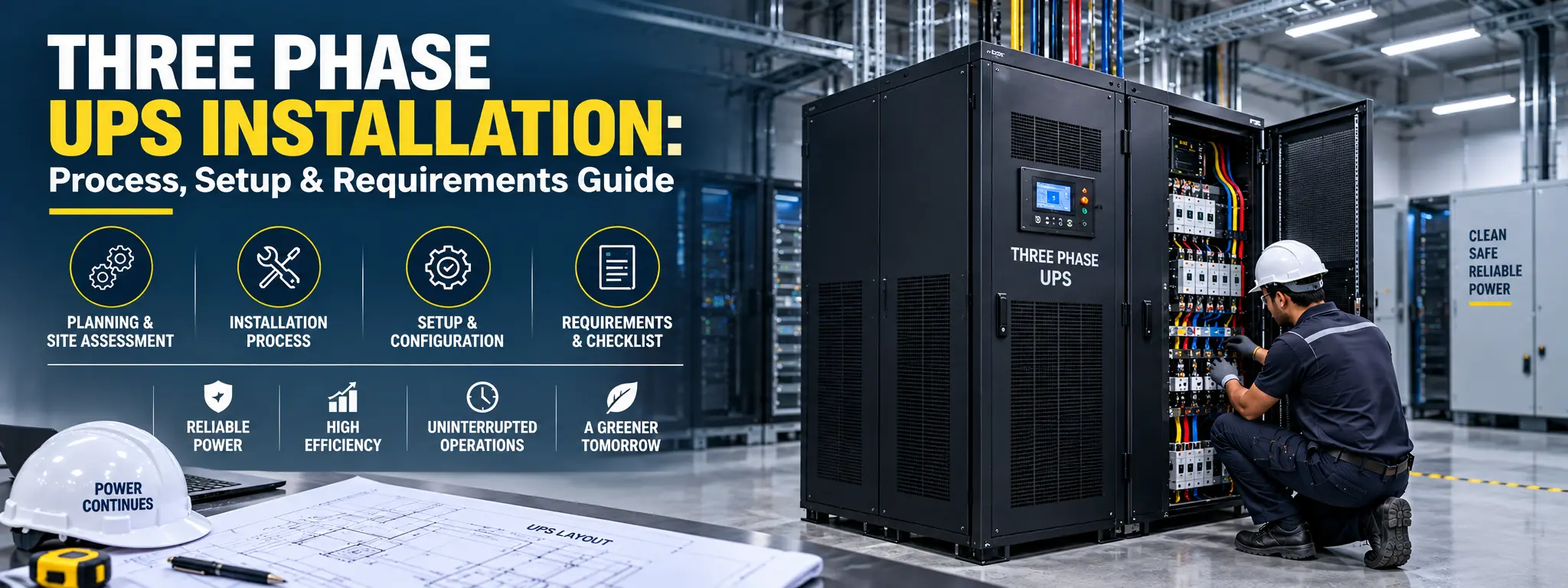
Three phase UPS installation is the process of connecting an uninterruptible power supply to a facility's three phase electrical infrastructure so that critical equipment continues running without interruption during a power failure. Unlike single phase installation, it involves balancing loads across three power lines, sizing battery banks for higher capacity, and meeting stricter electrical, space, and earthing requirements.This matters because three phase UPS systems are typically deployed where power interruption is not an option server rooms, hospitals, manufacturing lines, and commercial buildings.
A poorly planned installation can lead to load imbalance, overheating, reduced battery life, or system failure exactly when backup power is needed most.This guide walks through what a three phase UPS system involves, the site requirements you need to prepare, the installation process itself, and the mistakes that most commonly compromise reliability.
Single Phase vs Three Phase UPS: Key Differences
| Factor | Single Phase UPS | Three Phase UPS |
|---|---|---|
| Typical capacity | Up to 10–20 kVA | 10 kVA to 1000+ kVA |
| Power input | Single live wire + neutral | Three live wires (often + neutral) |
| Common use case | Small offices, individual servers, retail POS | Data centers, factories, hospitals, large commercial buildings |
| Load balancing | Not applicable | Required across three phases |
| Installation complexity | Low | Moderate to high, requires electrical engineering input |
| Battery backup scale | Small battery bank | Large battery bank, often in dedicated racks/rooms |
When Single Phase Is Sufficient
If your total critical load is under roughly 10 kVA and your building's incoming supply is single phase, a single phase UPS is usually the practical and cost-effective choice.
When Three Phase Is Necessary
Three phase UPS systems become necessary when the connected load is large, unevenly distributed across departments, or when the facility's incoming electrical supply is already three phase — which is standard in most industrial and larger commercial buildings.
Core Components of a Three Phase UPS System
Understanding the components helps clarify what the installation process actually involves:
- Rectifier/Charger - Converts incoming AC power to DC and charges the battery bank
- Battery Bank -Stores DC energy for use during outages; forms the three phase battery backup capacity
- Inverter - Converts DC battery power back to clean AC output during outages or power conditioning
- Static Bypass Switch - Automatically routes load directly to mains if the UPS itself needs servicing or faces an internal fault
- Isolation Transformer (where applicable)- Provides electrical isolation between input and output, and helps manage harmonics
- Control and Monitoring Panel - Displays load status, battery health, and alarms
Site Requirements Before Installation
A site survey is the starting point for any three phase UPS installation. The requirements generally fall into three categories.
Electrical Requirements
- Confirmation of a stable three phase power supply with correct voltage and frequency
- Dedicated, correctly sized incoming cable and circuit breaker for the UPS
- Proper cable sizing based on the UPS's rated current to prevent overheating or voltage drop
- A separate distribution board for UPS output to critical loads
Space, Ventilation & Environmental Requirements
- A dedicated, dust-free UPS room with adequate clearance around the unit for airflow and servicing
- Ambient temperature control, since batteries and electronics lose efficiency and lifespan in excessive heat
- Non-flammable flooring and, for larger installations, fire detection systems
- Sufficient floor loading capacity for battery banks and cabinets, especially for larger kVA ratings
Earthing and Safety Requirements
- A dedicated earthing/grounding system meeting local electrical safety norms
- Surge protection at the incoming supply point
- Clear labeling of panels, isolators, and emergency shutdown points
- Compliance with applicable national electrical codes and building safety regulations
Three Phase UPS Load Capacity Planning
Correct load capacity planning prevents both overloading and unnecessary oversizing. The general approach:
- List all critical loads- to be connected, in watts or kVA
- Add a growth margin - typically 20–30% — to account for future expansion
- Account for power factor-, since actual UPS sizing depends on both kVA and kW ratings of connected equipment
- Balance loads across the three phases- as evenly as possible to avoid one phase carrying a disproportionate share, which can trigger nuisance trips or reduce efficiency
- > Consider redundancy needs - some facilities use N+1 configurations, running two or more UPS units in parallel so one can fail without an outage
Undersizing a three phase UPS system is one of the most common planning errors, often caused by only calculating present-day load and ignoring future capacity needs.
Step-by-Step Three Phase UPS Installation Process
- Site survey and load assessment - An engineer evaluates the electrical infrastructure, available space, and total load requirement.
- System sizing and configuration selection - Based on the survey, the correct kVA rating, battery backup duration, and configuration (standalone or parallel redundant) are finalized.
- Civil and electrical preparation - The UPS room is prepared with proper flooring, ventilation, earthing, and cabling infrastructure.
- Positioning the UPS unit and battery bank-Equipment is placed according to manufacturer clearance and weight-load specifications.
- Electrical connections - Input, output, and bypass wiring is connected by qualified electricians, following correct phase sequencing.
- Battery bank wiring and configuration- Batteries are connected in the required series/parallel arrangement to achieve the target voltage and backup time.
- Initial power-up and diagnostics- The system is powered without load first to check the rectifier, inverter, and control panel functioning.
- Load bank testing - Where possible, the UPS is tested under simulated load to verify performance before connecting live critical equipment.
- Live load connection and monitoring - Critical loads are connected in stages, monitoring voltage stability and load balance across phases.
- Commissioning and handover - Final documentation, alarm configuration, and operator training are completed.
Three Phase Battery Backup: Sizing and Configuration
Battery backup time depends on battery capacity (Ah), the number of batteries in the string, and the connected load. Typical considerations:
- Backup duration is usually specified in minutes for facilities with generator backup, or hours for sites without one
- Battery type — Valve Regulated Lead Acid (VRLA) batteries are common for their maintenance-low profile, though other chemistries exist for specific requirements
- String configuration determines the DC bus voltage required by the inverter
- Temperature management directly affects battery lifespan; most manufacturers rate battery life at 20–25°C ambient, with life expectancy dropping significantly at higher temperatures
A practical example: A facility running 40 kVA of critical IT load with a 15-minute backup requirement (enough to allow a generator to start and stabilize) will need a smaller, lower-cost battery bank than a facility requiring 2 hours of backup with no generator support. This is why backup duration should be defined early, since it directly drives battery bank size, room space, and overall installation cost.
Common Installation Mistakes to Avoid
- Undersizing the UPS based only on current load, without accounting for future growth
- Skipping the site survey, leading to inadequate ventilation, cabling, or space
- Poor phase load balancing, which reduces efficiency and can cause premature component wear
- Incorrect earthing, which compromises both safety and equipment protection
- Ignoring battery room conditions, shortening battery life well below its rated years
- Using undersized cabling, which causes voltage drop and heat buildup under load
- Not testing under load before go-live, which risks discovering faults during an actual outage rather than during commissioning
Post-Installation Testing and Commissioning
Before a three phase UPS system is handed over for regular use, it should undergo:
- Input/output voltage and frequency verification across all three phases
- Battery charge and discharge testing
- Simulated mains failure test to confirm seamless transfer to battery power
- Static bypass switch functionality check
- Alarm and monitoring system verification
Skipping commissioning tests is a common shortcut that leaves failure points undiscovered until the system is actually needed.
Maintenance After Installation
Ongoing maintenance protects the investment made during installation:
- Periodic battery health checks and internal resistance testing
- Cleaning of ventilation filters and cooling components
- Load balance verification across the three phases
- Firmware and control panel checks
- Scheduled load bank testing to confirm actual backup performance, not just theoretical capacity
Facilities using their UPS as part of a broader power backup system should also review maintenance schedules alongside generator servicing, since many sites rely on both working correctly together.
Cost Factors in Three Phase UPS Installation
Costs vary significantly based on several factors, including UPS capacity, battery requirements, installation complexity, and whether you choose a new or recondition UPS system.
- UPS capacity (kVA rating) — larger systems cost more in both equipment and installation labor
- Battery backup duration — longer backup times require larger battery banks
- Redundancy configuration — N+1 or 2N setups cost more than standalone units but improve reliability
- Site readiness — facilities needing new cabling, earthing, or room modification will have higher installation costs than sites with existing infrastructure
- Installation complexity — multi-floor cable runs, parallel unit synchronization, or integration with existing building management systems add to labor cost
- Ongoing maintenance and AMC — long-term operating cost should factor into the overall decision, not just upfront installation price
Because these variables differ from site to site, a firm cost figure is only meaningful after a proper site survey and load assessment.
Choosing the Right Installation Partner
A three phase UPS installation involves electrical engineering judgment, not just equipment placement. When evaluating an installer or service provider, consider:
- Whether they conduct a proper site survey and load calculation before quoting
- Their experience with your facility type (data center, hospital, industrial, etc.)
- Availability of after-installation support, including AMC and emergency service
- Clarity on battery replacement cycles and warranty terms
- Transparent documentation of testing and commissioning results
At Power Solution Services, we assess the load, site conditions, and backup requirements before finalizing the UPS configuration. This helps ensure proper sizing, load balancing, battery capacity, and safe installation. Reviewing your load profile and backup duration is a useful first step before requesting a site survey
Conclusion
Three phase UPS installation is a technical process that goes well beyond connecting a unit to power — it requires accurate load assessment, proper site preparation, correct battery bank sizing, and thorough commissioning testing. Facilities that skip these steps often discover gaps in reliability during an actual outage, which is precisely when the system is meant to perform. Getting the fundamentals right — load balancing, earthing, ventilation, and backup duration planning — is what separates a UPS system that performs reliably for years from one that underperforms from day one.
If you're planning a three phase UPS installation, Power Solution Services provides guidance on load assessment, UPS sizing, battery requirements, and installation planning. Talk to us for expert guidance and a quote based on your power backup requirements.
Frequently Asked Question
1. What are the site requirements for three phase UPS installation?
A three phase UPS installation requires a stable three phase power supply, correctly sized cables and circuit breakers, adequate UPS room space, proper ventilation, suitable floor loading capacity, and dedicated earthing.
2. How is UPS load capacity calculated for a three phase UPS system?
UPS load capacity is planned by listing critical loads in watts or kVA, adding a growth margin, accounting for power factor, and balancing the load across all three phases. Redundancy requirements may also affect the final UPS capacity.
3. How long does a three phase UPS battery backup last?
Three phase UPS battery backup depends on the battery capacity, number of batteries in the string, connected load, and required backup duration. Sites with generator support may require minutes of backup, while facilities without a generator may need several hours.
4. What are the main steps in three phase UPS installation?
The process includes site survey and load assessment, UPS sizing, electrical and civil preparation, equipment positioning, electrical connections, battery configuration, initial power-up, load testing, live load connection, and final commissioning and handover
5. Does battery backup time affect the total 3 phase UPS installation cost?
Yes. A longer backup requirement generally needs a larger battery bank, which can increase equipment cost, space requirements, and installation complexity.
Related Post
Popular Post
 20 Aug 2022
UPS on Hire & UPS on Rent in Delhi, NCR - Powering Your Business with Flexibility and Reliability
In today's fast-paced business environment, uninterrupted power supply is crucial to keep operations...
Read More 20 Aug 2022
Unlocking the Power of UPS Renting Services: The Secret Ingredient in Delhi NCR
In a dynamic market like Delhi NCR, efficient logistics can make or break a business. UPS's renting ...
Read More 20 Aug 2022
How to Use Emerson UPS AMC & Repair Services To Desire
When it comes to ensuring the reliability of your critical power infrastructure, Emerson UPS (Uninte...
Read More